
We live in a complex, dynamic world filled with far more sensory information than our brains can effectively use to guide our behavior. I seek to understand how animals selectively gather and process sensory information to meet their ecological needs, and why sensory systems and behavior have evolved specialization.
To achieve this, my research program: (1) adapts visual attention and eye-tracking paradigms from human psychology to study gaze-shifting retinal movements in jumping spiders; (2) develops tools to investigate the neural mechanisms underlying visual perception and multi-eye integration; and (3) leverages spider diversity to explore the evolution of moveable eyes and distributed visual systems.
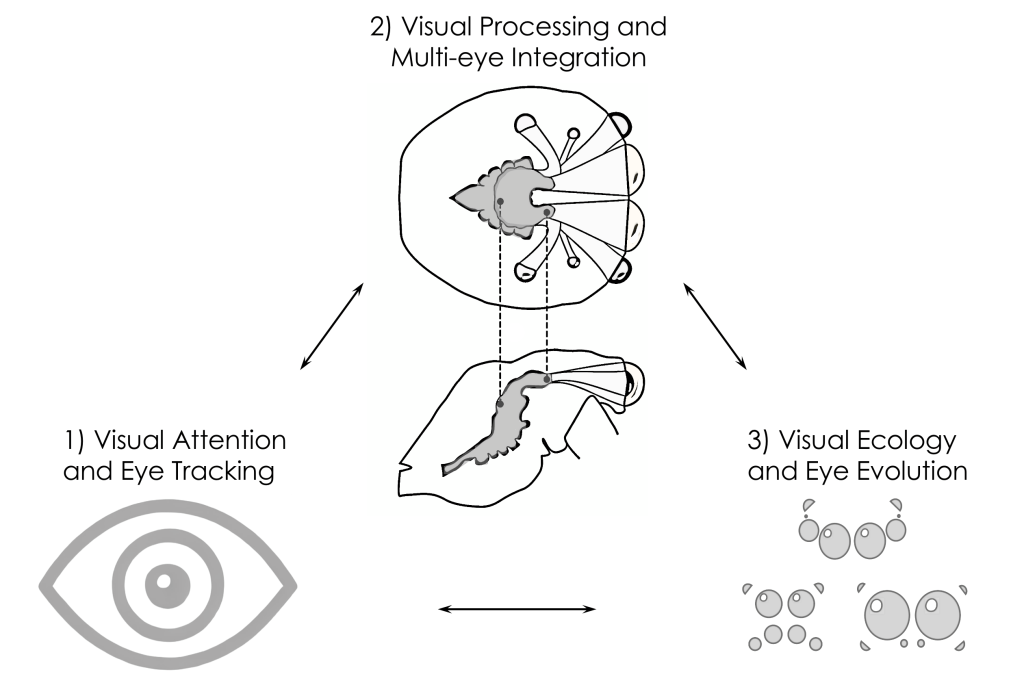
Jumping spiders are a diverse group of small, inquisitive predators that rely on highly advanced vision to explore new environments and guide their behavior. By using specialized pairs of eyes to divide the labor of vision, these animals achieve visual abilities that rival those of many vertebrates—all at a fraction of the size. To study how parallel streams of visual information are unified to form mental representations in the brain, I present visual stimuli to jumping spiders while simultaneously tracking their eye movements and neural activity.
I am devoted to research, teaching, inclusion, and science communication. I also serve as an Early-Career Representative for the International Society for Neuroethology. Explore the tabs in the sidebar to learn more.
 Alex M. Winsor